
Measure What Matters: Building an IDEA Dashboard That Drives Impact
Let’s be honest: diversity statements and awareness days don’t mean much without follow-through. If you want to move the needle on inclusion, diversity, equity, and accessibility (IDEA), you need more than good vibes. You need data. And not just any data—you need the right metrics, consistently tracked, analyzed, and acted on. Because here’s the thing: what gets measured, gets done.
Yet too many organizations still rely on “gut feel” to gauge inclusion. The result? A lot of noise, but not a lot of impact. A well-built IDEA dashboard doesn’t just capture what’s happening today—it becomes your north star for progress.
Why IDEA Metrics Matter 🔍
McKinsey’s Diversity Matters Even More: The case for holistic impact (2023) showed that companies in the top quartile for gender and ethnic diversity on executive teams were 39% more likely to outperform their peers. But the real headline is this: performance gaps grow wider when you don’t act.
McKinsey found that leadership diversity correlation remained strong, but the cost of inaction became clearer. Companies in the bottom quartile for both gender and ethnic diversity were 66% less likely to achieve above-average profitability. In other words, when you ignore IDEA, your bottom line pays for it.
Key IDEA KPIs to Track
Here are the metrics that matter—because without them, accountability is just lip service.
1. Representation at All Levels
Track demographics—gender, race, disability, LGBTQIA+ identity, etc.—not just at entry level but across every level of the organization. Progress is only real when it shows up in decision-making roles.
2. Turnover and Retention
Who’s leaving, and why? Analyze turnover trends by demographic group. Pair this with exit interviews and stay interviews to reveal cultural cracks before they become chasms.
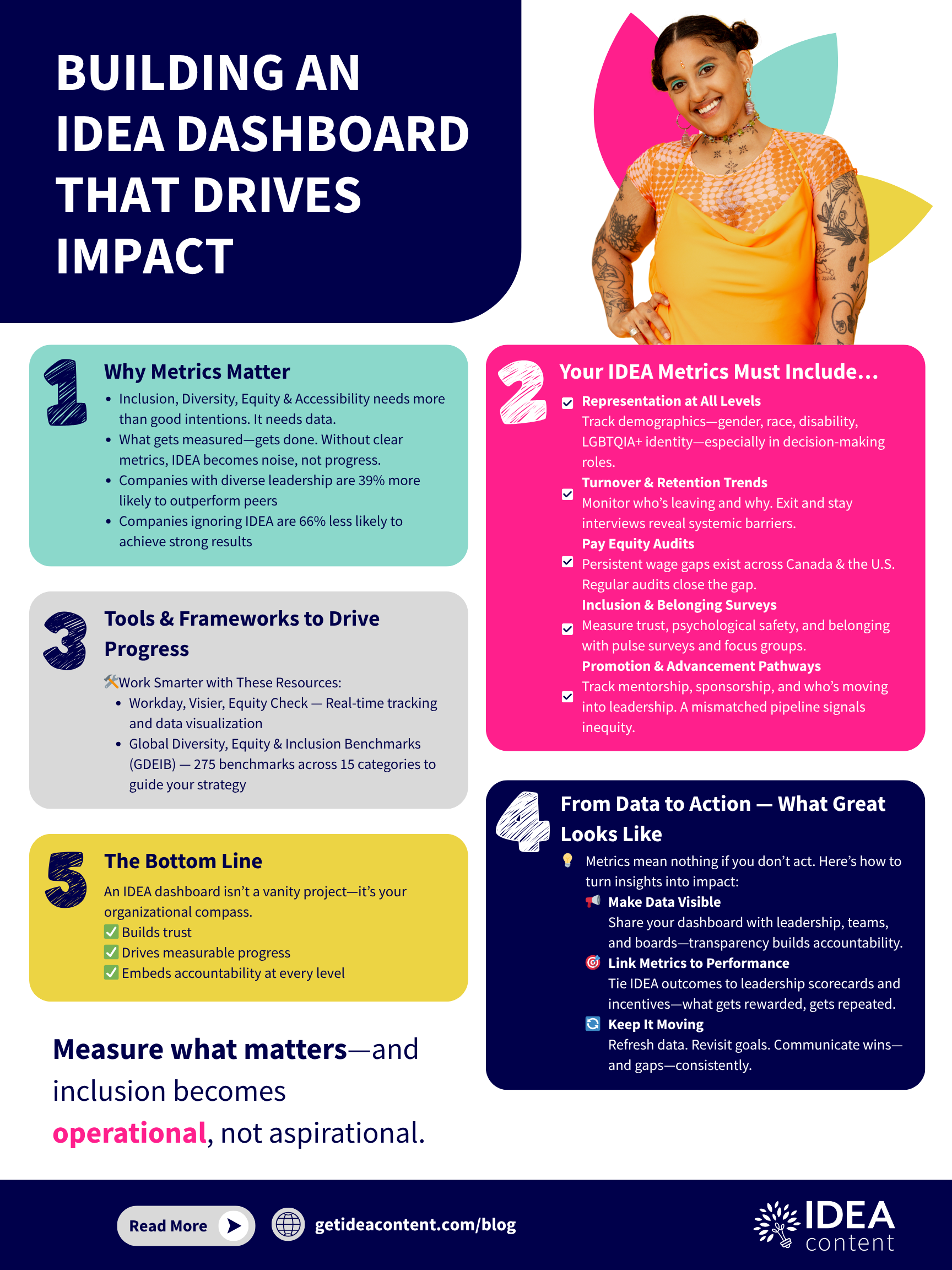
3. Pay Equity Audits
Ongoing analysis of pay equity is a must. Statistics Canada shows persistent gender and racial pay gaps, despite increased awareness. Payscale's 2025 report also reveals troubling trends in unexplained wage disparities.
4. Inclusion & Belonging Surveys
Pulse surveys help measure psychological safety, trust, and a sense of belonging, elements that numbers alone can’t fully capture. Combine this with focus group data for deeper insights.
5. Promotion and Advancement Pathways
Track who’s being mentored, sponsored, and promoted. If your leadership pipeline looks nothing like your workforce, that’s a signal, not a coincidence.
Tools & Frameworks to Make It Happen
It’s not all spreadsheets and pivot tables. Today’s platforms make data collection easier and more insightful:
Workday, Visier, and Equity Check tools provide visualization, real-time tracking, and trend analysis.
The Global Diversity, Equity & Inclusion Benchmarks (GDEIB) offer 275 benchmarks across 15 categories, helping you map where you are—and where you should be. You can also explore the 2024 GIDEAB primer for practical guidance.
From Data to Action: What Great Looks Like
So, you’ve built the dashboard. You’ve got the metrics. Now what? Data without action is just decoration. The real power of an IDEA dashboard comes when it drives decision-making, shapes priorities, and keeps your organization accountable. This is where many initiatives stall: collecting the numbers, but failing to connect them to outcomes. Let’s talk about how to turn that insight into action, and what good looks like when IDEA is truly operationalized.
Make Data Visible: IDEA dashboards shouldn’t sit on one person’s laptop. Share metrics with leadership, departments, and even your board.
Link Metrics to Performance: Set clear goals tied to incentives. When IDEA is part of leadership scorecards, priorities shift.
Keep It Moving: Revisit your dashboard regularly. Refresh goals, update benchmarks, and communicate progress, or lack thereof.
The Bottom Line
An IDEA dashboard isn’t a vanity project. It’s a powerful, practical tool for driving sustainable change. Done right, it builds trust, shows progress, and holds everyone accountable; from front-line staff to the C-suite.
Because when you measure what matters, inclusion stops being aspirational—and starts being operational.
For more information on how IDEA Content can support your measurement journey, check out our Certificate Programs. If you’d like to learn more about measurement with Employee Resource Groups, download our free ERG Guide.
IDEA Content is here to help with making your workplace more inclusive. We have hundreds of communications templates, policy templates, and ready-to-use toolkits designed to make your life easier. Become a free subscriber today (yes, it’s really free) to check out a selection of our offerings. Learn more